YouTube outlier videos: how to find ideas worth making
Learn what makes a video an outlier, how to evaluate its context, and how to turn the evidence into an original video brief.
The quick answer
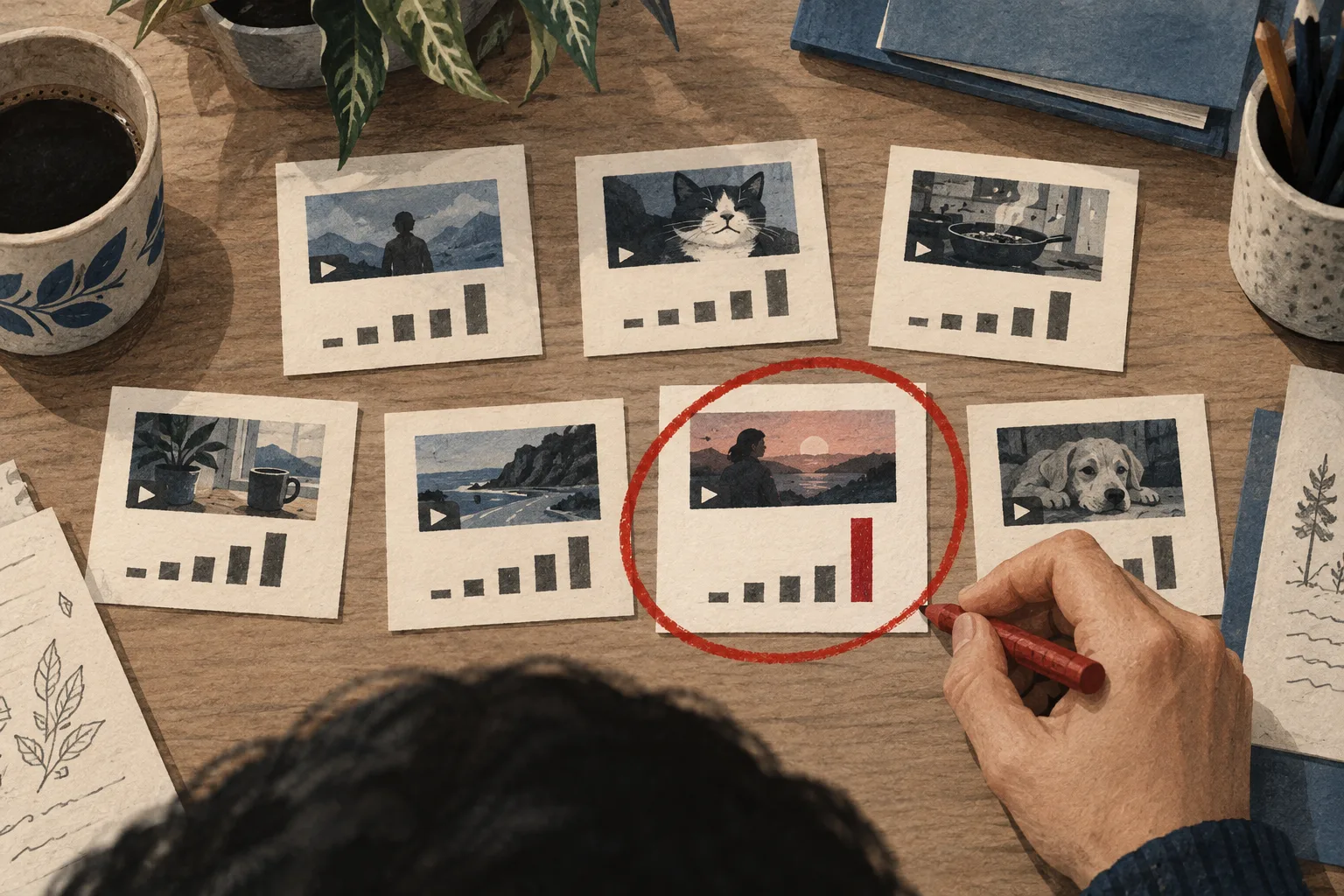
A YouTube outlier is a video that substantially outperforms its channel's usual results. Research outliers to find unusually strong audience interest, then check the topic, format, age, and production constraints before adapting the underlying idea.
In this guide
Why a smaller number can be the stronger signal
Imagine two hypothetical uploads. One gets 800,000 views on a channel whose comparable videos usually reach a million. The other gets 45,000 views where 5,000 is typical. The second upload is the more unusual result. Its audience responded far beyond that channel's normal reach.
That observation changes the research question. Instead of asking which video is biggest, ask what made this particular promise unusually attractive to this particular audience. You might discover a neglected beginner problem, a compelling demonstration, or a familiar topic presented through a new constraint.
The result is evidence to investigate, not a promise that your version will perform the same way. Distribution, audience trust, timing, and the creator's execution also matter.
Build a useful comparison set
Start with one viewer problem, such as recording clear audio in a noisy apartment. Search related phrasing and collect videos from several channels. Separate long-form videos from Shorts. Give recent uploads room to accumulate views, and distinguish an old search tutorial from a timely product launch.
Use these fields in your research notes:
| Field | What it helps you decide |
|---|---|
| Viewer and problem | Whether the audience matches yours |
| Relative performance | Whether the result was unusual for the channel |
| Upload age and format | Whether comparisons are reasonably fair |
| Title and visual promise | Why someone might choose this video |
| Evidence inside the video | Whether you can deliver a similarly useful result |
| Your original contribution | Why your version deserves to exist |
Look for several independent examples. Five uploads from one creator may reflect that person's loyal audience rather than broad demand. Three creators reaching the same neglected problem through different formats offer a more useful starting point.
Separate the topic from the mechanism
A video titled “I fixed my echo without buying a microphone” contains more than a keyword. Its mechanism is a familiar frustration, an avoided expense, and a visible before-and-after demonstration. Those elements are portable; another creator's exact script and thumbnail are not.
An original adaptation might test three apartment-friendly room treatments using the equipment you already own. You would preserve the useful viewer question while changing the experiment, footage, explanation, and conclusion. The research gives you a direction; your work supplies the value.
Write down two explanations for the outlier. Perhaps the budget constraint attracted beginners. Perhaps a newly released microphone caused a temporary surge in interest. Seek another example that can help distinguish those explanations before committing a week of production.
Turn a saved video into a decision
A useful brief can fit on one page:
- Viewer: a beginner recording spoken audio in a rented room.
- Problem: echo makes a good microphone sound disappointing.
- Promise: hear which reversible room changes improve the recording.
- Proof: matched before-and-after recordings with the same settings.
- Packaging: one audible comparison in the opening and a clear visual contrast.
- Constraint: no permanent installation and a stated spending cap.
- Next test: whether viewers prefer the result-led or problem-led title.
This brief is more valuable than a folder containing fifty unexplained screenshots. It tells you what to film, what to leave out, and what a viewer should gain.
Keep research close to production
Vidfora's outlier database makes relative performance available while you browse. Saved boards help keep reference videos together, and the Video projects area provides a place to develop the next video. Keep your explanation of the pattern in the project brief so the reason for choosing it survives the handoff.
For the scoring details, read how an outlier score works. Before filming, run the idea validation process. Your goal is not a perfect forecast. It is a better-supported production decision, with a clear reason to make the video and an equally clear reason to reject it.
Common questions
How many views does a video need to be an outlier?
There is no universal view threshold. A video's performance must be compared with a relevant channel baseline. A small channel's 20,000-view upload can be more unusual than a large channel's million-view upload.
Should I copy an outlier video's topic?
Use it to investigate an audience need. Create your own evidence, perspective, examples, and packaging. A repeated topic only earns a new video when you can add something useful.
Published by Vidfora, the product discussed in these guides. Examples are illustrative unless a source is named. Editorial approach · Suggest a correction