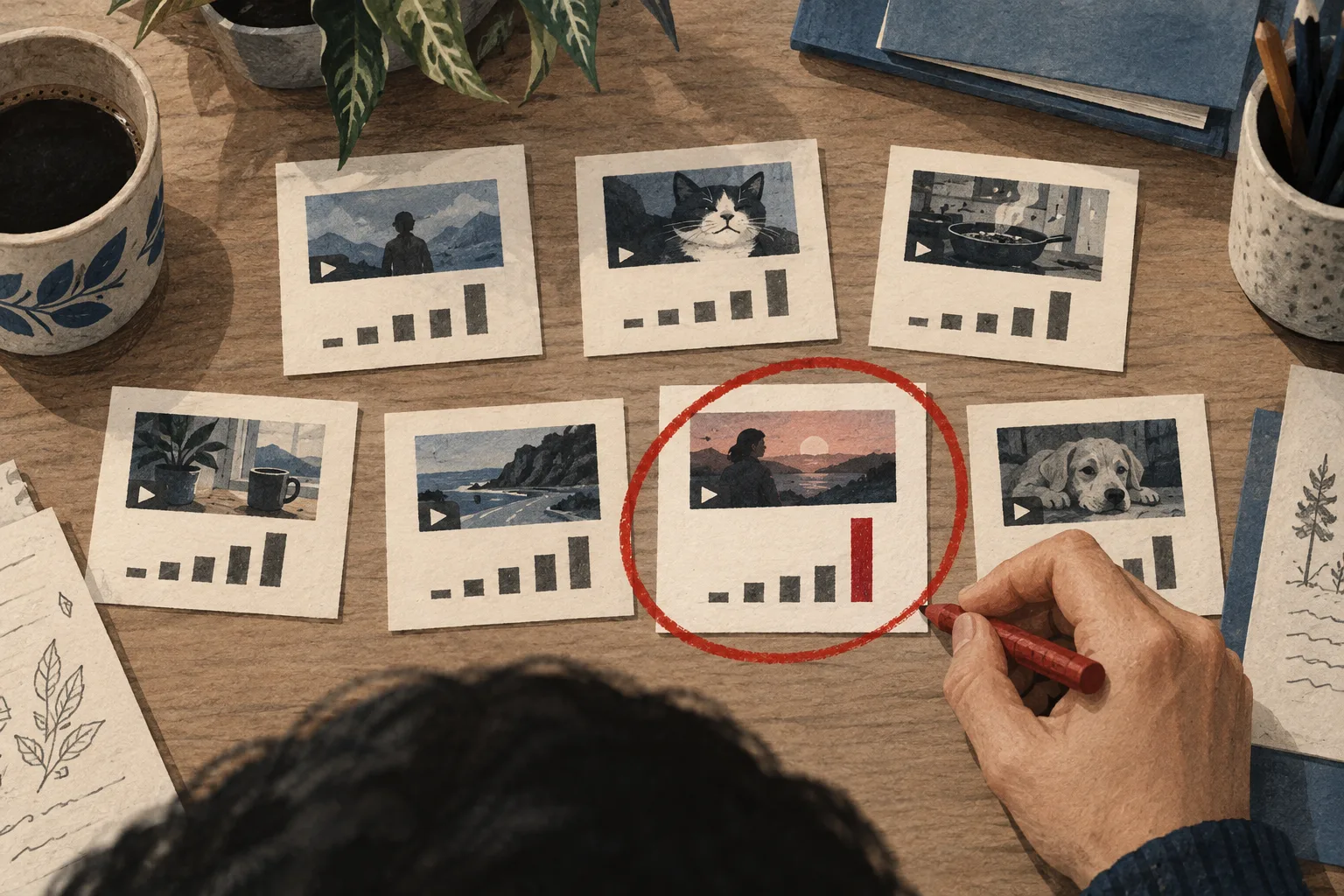
Low YouTube impressions: a diagnosis checklist before you panic
Check topic fit, audience context, packaging clarity, and data maturity before treating limited reach as proof that your video failed.

The quick answer
Low impressions do not identify a single cause. Review the video's age, topic, intended audience, traffic context, and packaging clarity, then compare relevant uploads. Strong-looking CTR or retention on a small sample does not guarantee wider distribution.
In this guide
A small gaming channel in this Reddit discussion reported a video with far fewer impressions but a much higher CTR than an earlier upload. The question was reasonable: if the percentage is better, why is the reach smaller?
The missing detail is who saw each video. A high response from a narrow group does not tell you how a broader group would respond. YouTube's CTR FAQ explicitly describes this pattern and explains that videos compete with other things each viewer might watch—not just your previous uploads.
Put the denominator beside the percentage
Imagine two hypothetical uploads. One has 500 counted impressions and a 20% CTR: about 100 views from those impressions. The other has 10,000 impressions and a 4% CTR: about 400 views from counted impressions. The lower percentage accompanies four times as many of those views.
This arithmetic does not prove either thumbnail is better. The audiences, topics and traffic sources may differ. It does show why “20% beats 4%” is too little information for a reach diagnosis. Do not substitute total views into this calculation; some views do not come from counted impressions.
Write these items together in your notes: impressions, CTR, publication age, main traffic source and the question the video answers. A screenshot showing only the best percentage leaves out the comparison you need.
Check for a real publishing problem first
Confirm the intended visibility and inspect actual restriction notices in Studio. Make sure the uploaded video plays correctly and the title describes the published file. These checks address observable problems.
If those checks pass, low reach alone does not establish a hidden account penalty. Avoid turning an unexplained outcome into a claim you cannot verify. A new channel, a narrow question and a topic outside the usual audience are different circumstances, even when all three produce a small count.
Ask whether the topic has a larger audience
Suppose a tutorial repairs one error in an old model of audio recorder. A clear title may attract a high share of people who encounter it because the problem is exact. That does not mean many people currently need the repair.
Search for the viewer's problem in their own language. Inspect several relevant videos, their publication ages and the questions people still ask. Public results can suggest demand; they cannot reveal another channel's private impressions or retention. The idea-validation guide gives a research process for deciding whether to make a broader follow-up.
For the narrow tutorial, success might be a small number of viewers completing the repair. For a broad entertainment video, the goal and comparison set would be different. Decide which kind of video you made before calling its reach a failure.
Fix a visible packaging problem, not an imaginary threshold
Show the title and thumbnail at a small size to someone who resembles the intended viewer. Ask what they expect to learn or see. If they cannot identify the problem, or they expect a different outcome, you have a concrete mismatch to address.
For example, “This Changed Everything” beside a tiny circuit board hides the repair. “Fix the Recorder That Stops After 30 Seconds” identifies it. That second title is a proposed clarity improvement, not a promise of higher CTR.
If you have a suitable native experiment available, test a meaningful packaging difference. If you simply replace the image, record that it was an editorial correction rather than a controlled experiment.
Choose the next action from the finding
| Finding | Next action | What it does not establish |
|---|---|---|
| Incorrect visibility or an explicit restriction | Resolve the actual issue using Studio guidance | Every low-view video has the same issue |
| Clear title/thumbnail mismatch | Correct the promise or prepare a test | A guaranteed reach increase |
| Narrow but still useful problem | Keep the guide and judge the relevant outcome | The whole niche lacks demand |
| Too little comparable evidence | Set a review point tied to your production cycle | A universal waiting period |
| Weak opening after the click | Inspect and improve the explanation | More impressions would solve the video |
Save the observation and return when you have new evidence. Repeated refreshes of the same small sample do not create a stronger diagnosis. If you are considering deleting the upload, read the replacement decision guide first.
Common questions
Does low reach mean my channel is shadowbanned?
Low impressions alone do not establish that explanation. Check actual account notices and the video's context, and avoid inferring an unseen restriction from one performance pattern.
Should I delete and reupload a low-impression video?
Do not make that the automatic response. First identify a concrete issue and consider whether a correction, packaging test, or better future video addresses it. Reuploading without a diagnosis may repeat the same problem.
Published by Vidfora, the product discussed in these guides. Examples are illustrative unless a source is named. Editorial approach · Suggest a correction