Research YouTube thumbnails without copying another creator
Study composition, contrast, proof, and audience expectations, then turn visual references into an original packaging brief.
The quick answer
Use thumbnail research to identify design principles and viewer expectations, not to reproduce another creator's composition. Compare strong and ordinary examples, record what each visual communicates, and build a new image around your own subject and evidence.
In this guide
Study the communication problem
Start with the kind of promise your video makes: comparison, transformation, explanation, challenge, or story. Look for references solving a similar communication problem even if they come from a different subject.
A restoration thumbnail may teach you how to show a before-and-after clearly. A product comparison may teach you how to separate two options. The useful lesson is the relationship between elements, not the exact objects, expression, or color scheme.
Collect a balanced visual sample
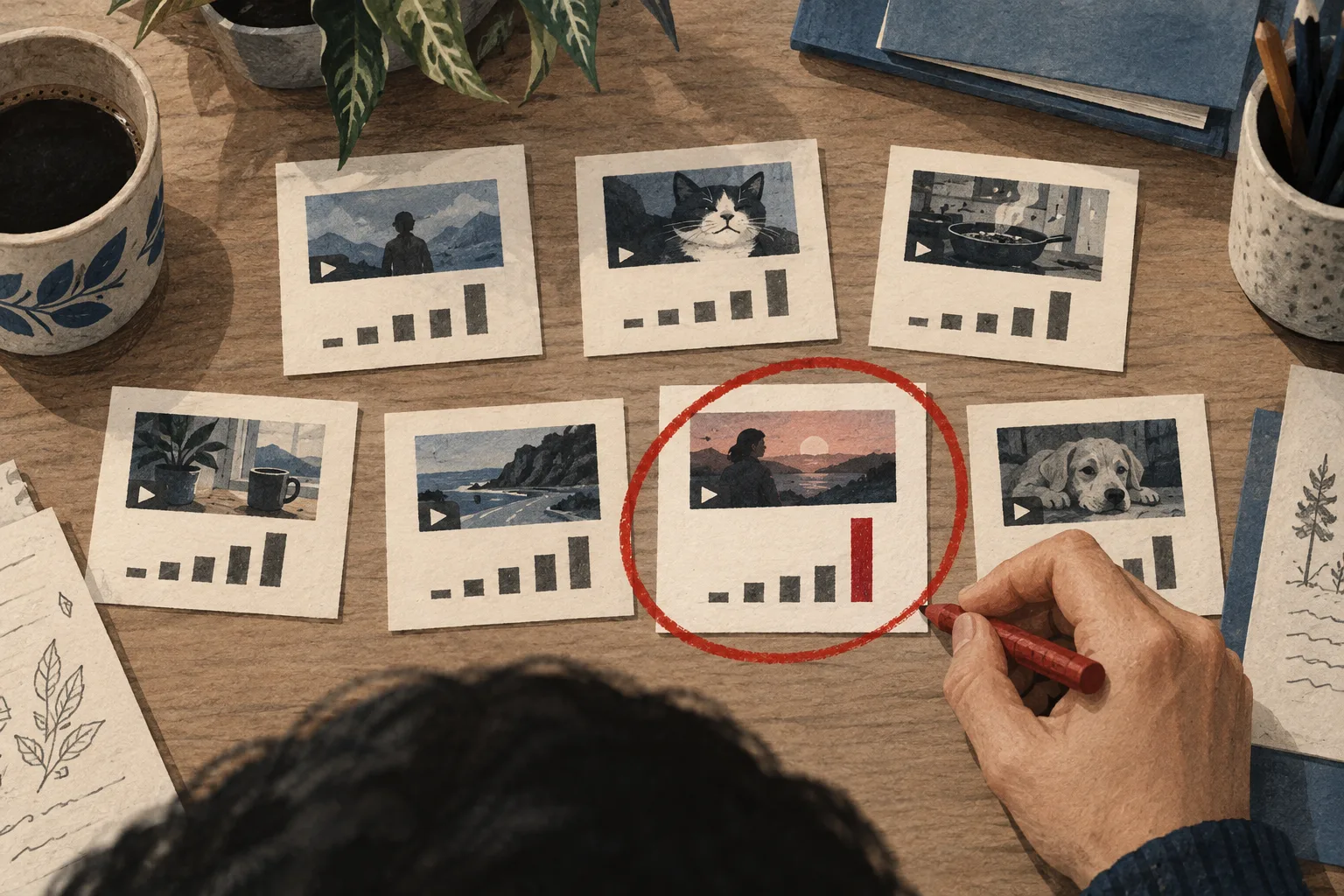
Include relevant outliers and ordinary-performing videos. If the same visual feature appears everywhere, it may be a category convention rather than the reason one upload succeeded.
Record the title beside each thumbnail. An image's meaning often depends on the words around it. Studying thumbnails in isolation can make a mysterious composition seem clever when the title is doing most of the explanatory work.
Annotate the mechanism
For each reference, answer:
- What is noticed first?
- What question does the image raise?
- What does the title explain that the image leaves open?
- Which part appears to provide proof?
- What becomes unclear at small size?
- Which audience assumptions are built into the design?
Avoid notes such as “use red” unless you can explain what the red is doing. It might separate the subject, identify a category, or simply match the creator's established branding.
Translate the principle to your evidence
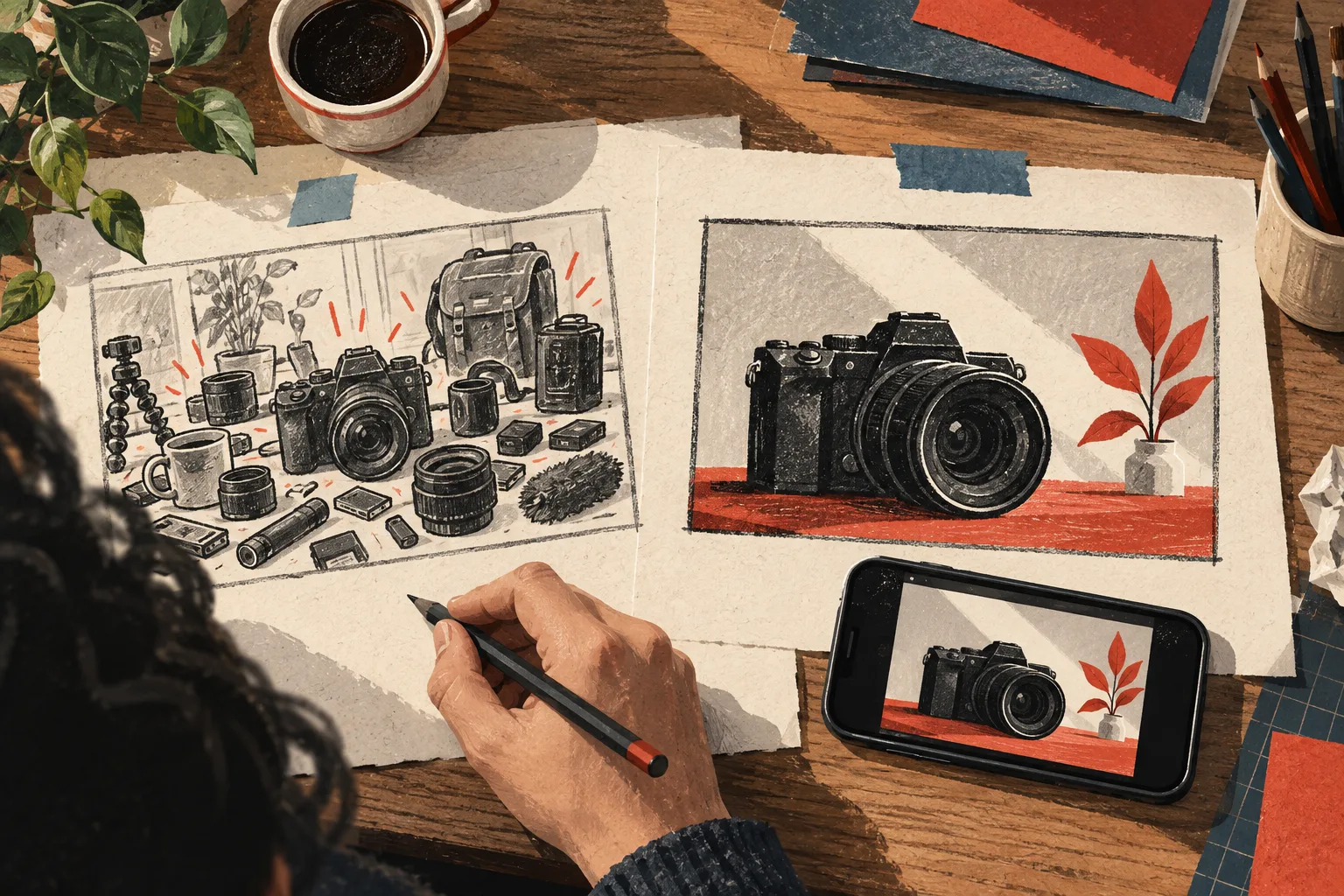
Suppose a reference shows a cramped workspace beside a finished transformation. Your video compares two ways to store equipment in a shared room. The transferable principle is visible spatial contrast, not the original creator's room layout.
Create your own photographs and composition. Show the actual storage methods you tested. If the most dramatic reference exaggerates the problem, keep the useful hierarchy while rejecting the misleading treatment.
Make an original concept sheet
Write three concepts using your own materials. For each, specify the main subject, the contrast, the title's role, and the footage that supports the image.
Then identify what makes the concept yours: a distinctive test condition, a recognizable object from the video, a new explanation, or a documented result. If you cannot describe the difference without saying “same but with my face,” return to the underlying promise.
Use visual search with judgment
Vidfora's thumbnail search helps you find and compare visual references. Save a focused set in a board and preserve your interpretation in the project brief.
Do not treat a visually similar result as a recommendation to imitate it. Similarity can help locate a design family, but the audience, topic, and execution still determine whether the reference is useful.
Review the final design independently
Hide the references and inspect your thumbnail beside the title. Does it communicate the video's value without requiring familiarity with the inspiration? Does it accurately represent your work? Is it readable in a feed?
The aim is to become better at seeing why a design communicates, so your next original concept is easier to develop. A research process that only increases dependence on copying has missed that opportunity.
Common questions
Can I use another creator's thumbnail as inspiration?
You can study general principles such as hierarchy, contrast, and framing. Create your own assets and composition, and avoid reproducing distinctive creative elements or implying another creator's endorsement.
Does a common thumbnail style prove it works?
No. A style may be common because creators imitate one another. Compare context and outcomes carefully, and use your own audience tests when you need stronger evidence.
Published by Vidfora, the product discussed in these guides. Examples are illustrative unless a source is named. Editorial approach · Suggest a correction