A practical YouTube story structure for videos that need an explanation
Use a goal, obstacle, attempts, evidence, and consequence to make tutorials and experiments feel coherent without inventing drama.
The quick answer
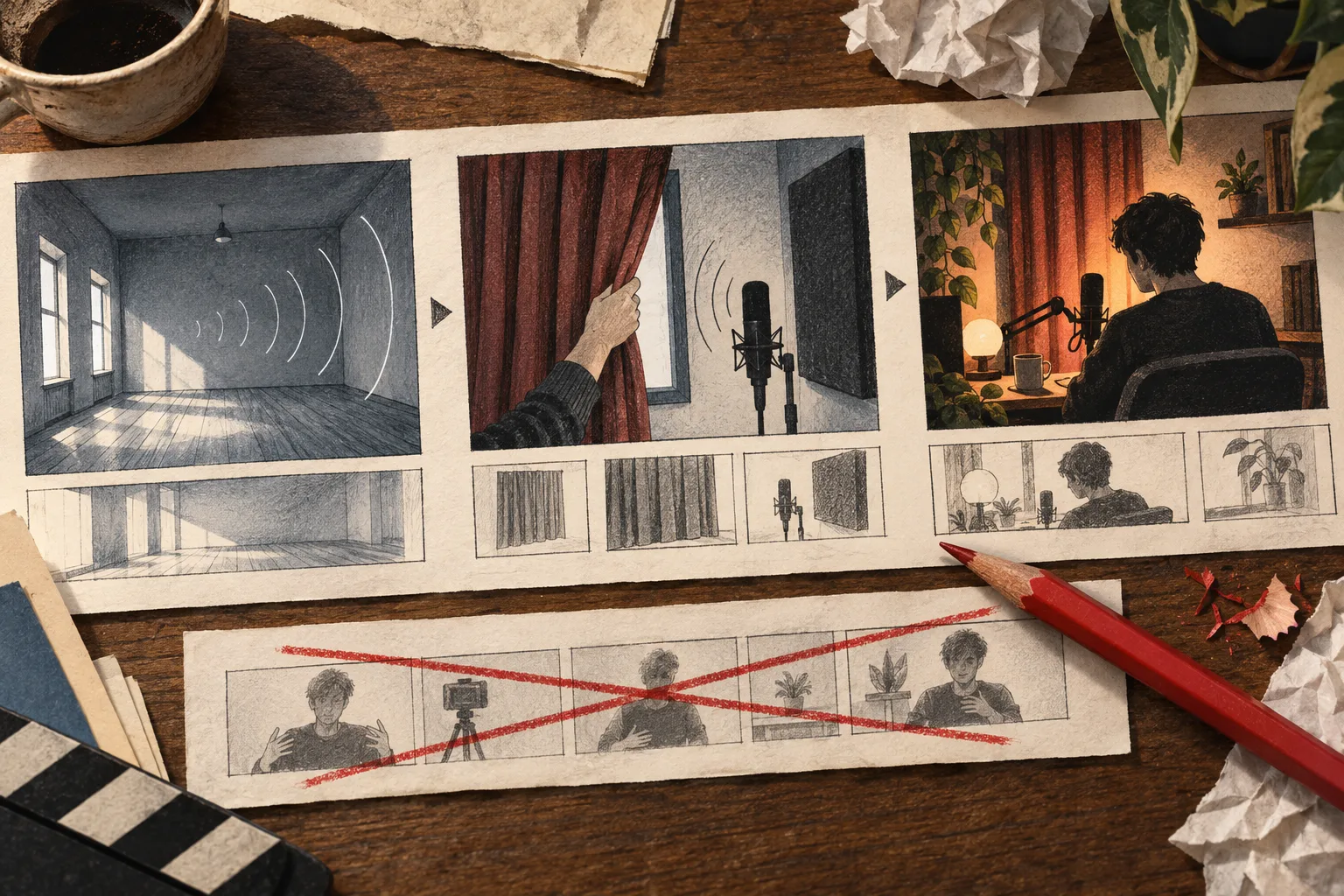
A useful story structure connects a goal to an obstacle, shows meaningful attempts, and explains what changed. For educational videos, the story can be the process of solving a problem. Keep the tension grounded in real uncertainty rather than manufacturing conflict.
In this guide
Find the real change
A story needs movement between states. A workspace is unusable and becomes functional. A test begins with an assumption and produces a more qualified answer. A beginner misunderstands a process and learns the step that makes it work.
Write the starting state and the ending state. If nothing changes, the video may be better organized as a reference guide or comparison. Not every useful video needs a dramatic narrative arc.
State the goal and constraint
The goal explains what success would look like. The constraint makes the process specific. “Build a recording setup” is broad. “Build a setup that can be packed away before dinner” introduces a practical challenge.
Show the constraint honestly. If the space, budget, or deadline is invented for the video, explain it as an intentional challenge rather than implying it was an unavoidable real-life crisis.
Choose attempts that teach something
A sequence of attempts is useful when each changes your understanding. Perhaps the first desk layout fits the equipment but blocks the door. The second clears the door but makes the camera angle awkward. The final arrangement balances the constraints.
Do not include every failed adjustment merely because it happened. Select the attempts that explain the eventual decision. The viewer needs the logic of the process, not a complete recording of your frustration.
Put evidence at the turning points
When the story changes direction, show why. A measurement, a test clip, a visible failure, or a concrete observation gives the decision credibility.
Avoid replacing evidence with narration such as “then I realized the secret.” Explain what you noticed and how it affected the next step. That makes the story useful to someone facing a similar problem.
Use this planning table
| Beat | Question to answer |
|---|---|
| Starting situation | What is not working, and for whom? |
| Goal | What would a useful outcome look like? |
| Constraint | What makes the obvious solution insufficient? |
| Attempts | Which choices reveal meaningful tradeoffs? |
| Turning point | What evidence changes the approach? |
| Outcome | What worked, what did not, and under which conditions? |
| Transfer | What can the viewer apply to their own situation? |
The table helps preserve the causal thread. If a section cannot connect to the next decision, it may be a detour.
End with an earned conclusion
Show the final state and acknowledge remaining limitations. A small-room solution may improve the workflow without becoming a perfect studio. That qualification can make the result more useful because viewers can judge whether the tradeoff fits them.
The conclusion should answer the question established by the title and opening. A dramatic story that ends with a vague lesson can feel less satisfying than a modest experiment with a clear result.
Develop the story from your research
Use relevant outliers to study how creators establish goals and reveal evidence, then build the sequence around your own work. Vidfora's Coach can help identify missing causal links or unnecessary detours in a draft.
Ask it to preserve the actual facts and flag places where the script invents certainty or drama. The strongest story is often already present in the decisions you made; the writing task is to make that reasoning visible.
Common questions
Does every tutorial need a story?
No. Some tasks are best served by a direct sequence of instructions. Story structure helps when the viewer benefits from understanding obstacles, tradeoffs, or how an answer was discovered.
Can I rearrange events for clarity?
You can organize explanations to help viewers understand, but avoid creating a false account of what happened or implying causation the evidence does not support. Keep the essential sequence of decisions honest.
Published by Vidfora, the product discussed in these guides. Examples are illustrative unless a source is named. Editorial approach · Suggest a correction