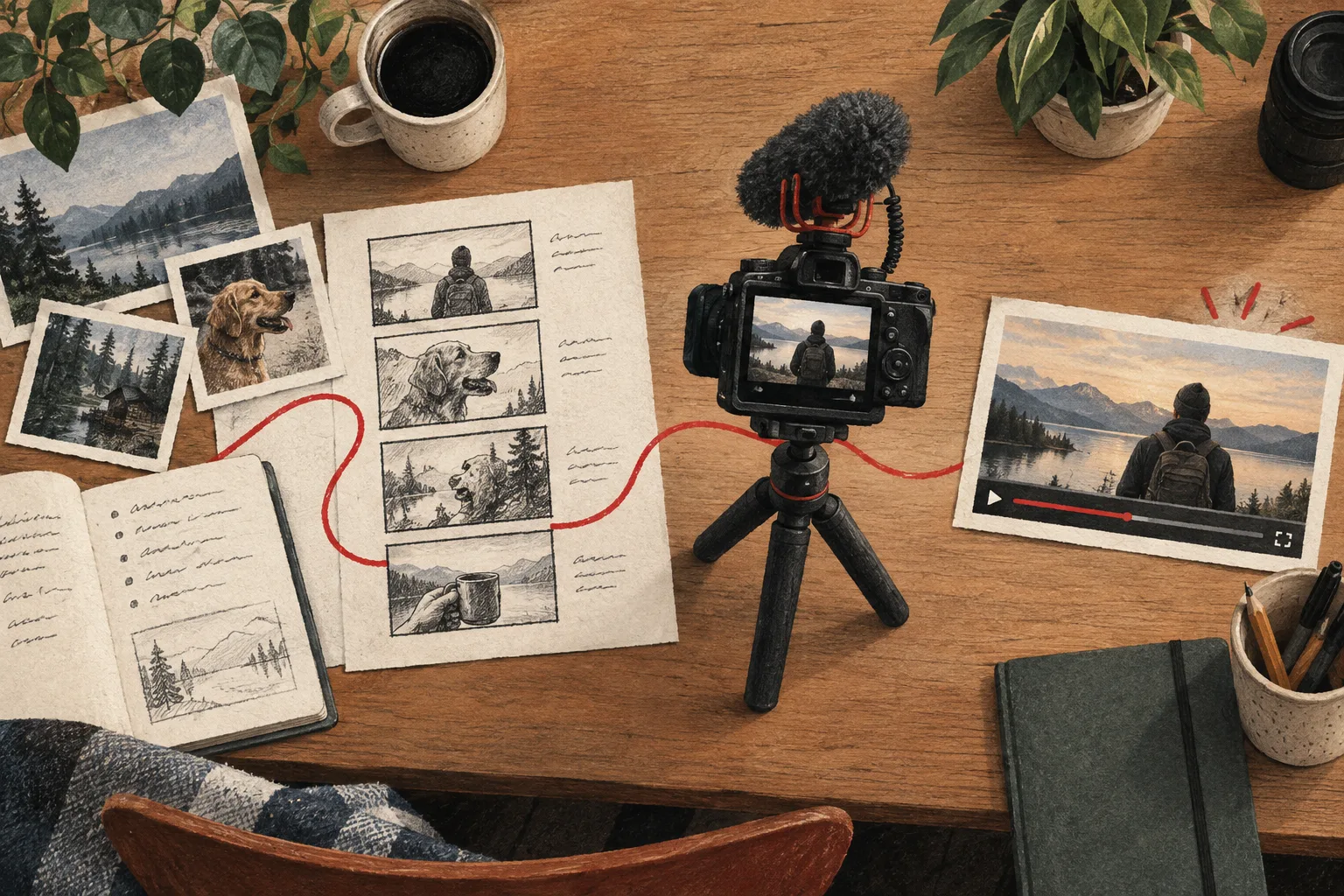
YouTube title generator prompts that produce useful alternatives
Give AI the viewer, evidence, constraints, and thumbnail concept so generated titles become realistic options instead of generic clickbait.

The quick answer
A strong title-generation prompt specifies the intended viewer, the video's supported payoff, the evidence shown, and claims to avoid. Ask for distinct strategic angles with explanations, then reject options that overstate the content or conflict with the thumbnail.
In this guide
Give the generator a decision brief
“Write viral titles about productivity” invites generic exaggeration because the model has little useful context. Start with the actual video: what you tested, what happened, who benefits, and what remains uncertain.
For a planning-workflow video, explain whether you tried the method yourself, how long you used it, and which result you can demonstrate. If you did not measure productivity, do not ask for titles claiming a percentage improvement.
Use this prompt structure
I am making a video for freelance designers who lose track of small client tasks. The video demonstrates a five-field task board using a real example project. It does not prove a time-saving percentage. Generate nine title options: three problem-led, three result-led, and three constraint-led. Keep each understandable without specialist vocabulary. For every title, explain the viewer expectation and flag any claim that needs stronger evidence.
The prompt defines the audience, evidence, limits, and the kind of variety you want. It also asks the model to expose its interpretation, which makes review easier.
Add the thumbnail context
Describe what the image will show: a cluttered task list beside a simplified board, for example. Ask for titles that complement the contrast without repeating every visible word.
If the model suggests a title about a dramatic business transformation, compare it with the modest demonstration you actually filmed. The mismatch is a reason to reject the title, not a reason to retroactively pretend the video proves more.
Request angles before polishing
Ask for different promises first. Once you choose a promising angle, request shorter wording, clearer nouns, or a more natural voice. Generating twenty near-synonyms of an uncertain premise creates volume without improving the decision.
A useful sequence is:
- Identify three plausible audience promises.
- Check which promise the footage best supports.
- Generate wording variations for that promise.
- Pair the strongest options with the thumbnail.
- Ask a target viewer what each pair implies.
This sequence keeps the creative work anchored to the content rather than the generator's preference for dramatic language.
Use a rejection rubric
Reject titles that invent results, imply a test you did not run, hide the subject entirely, or depend on a claim you cannot explain. Also reject options that sound unlike your channel if the voice would create a false expectation.
Keep a few imperfect but informative alternatives. One may reveal that you need a clearer example or a different opening. Title generation can diagnose a weak brief as well as produce copy.
Bring research into the prompt responsibly
You can describe patterns observed in relevant outliers: a practical constraint, an explicit comparison, or a visible before-and-after. Do not ask the model to reproduce another creator's exact title and merely swap a noun.
Vidfora's title generator sits alongside the research and packaging workflow. Use the references to clarify the audience need, then make the wording reflect your original evidence. The final title is your editorial choice; the model's confidence is not a measurement of likely performance.
Common questions
How many AI-generated titles should I request?
Request enough to compare genuinely different approaches, then narrow the direction. A small set of distinct angles is usually easier to evaluate than dozens of minor word changes.
Can an AI title score predict CTR?
Treat a model's score as a heuristic unless it is explicitly backed by a validated measurement method. It does not replace actual audience data or establish a guaranteed click-through rate.
Published by Vidfora, the product discussed in these guides. Examples are illustrative unless a source is named. Editorial approach · Suggest a correction