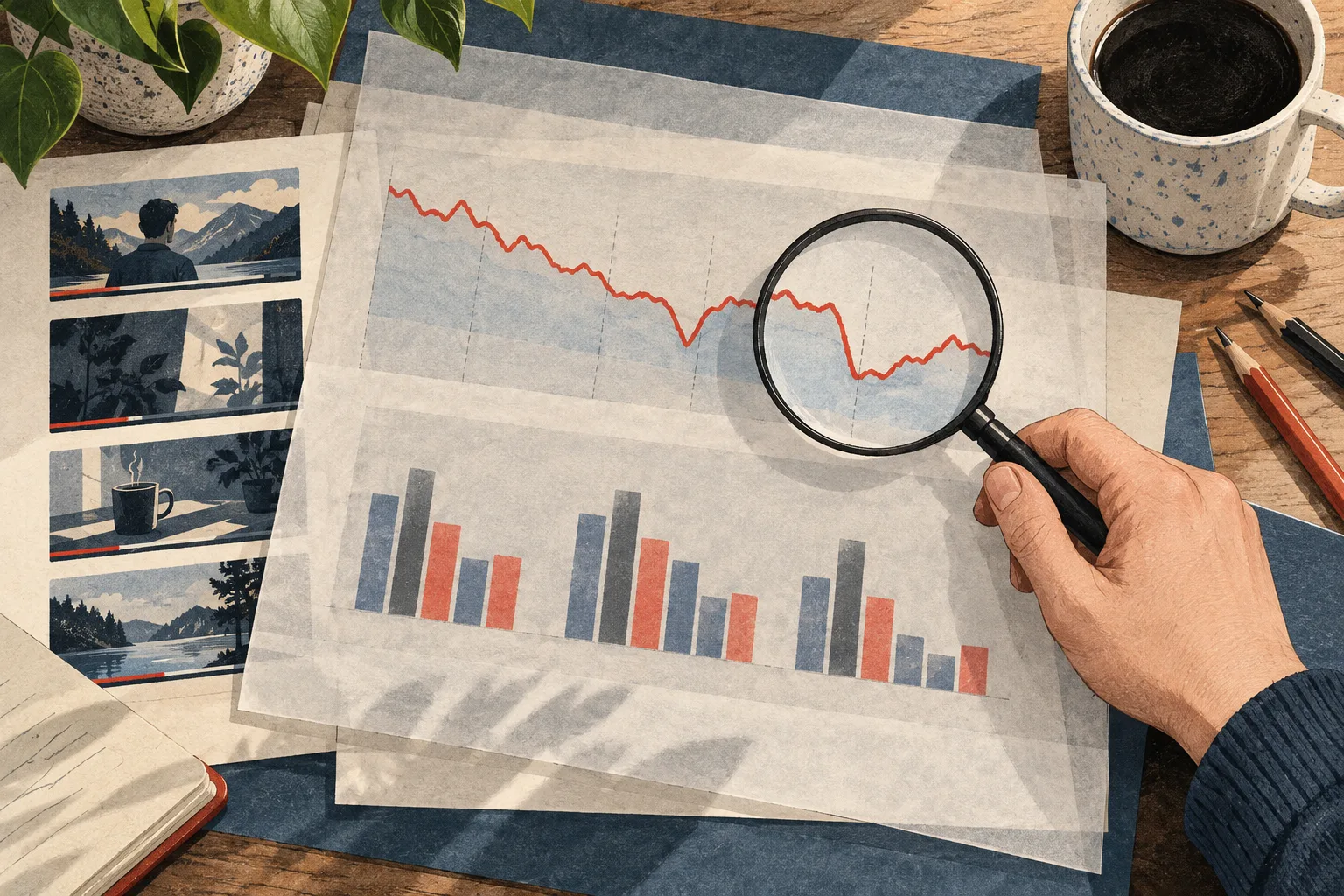
Design YouTube growth experiments you can learn from
Turn vague improvement goals into specific hypotheses, controlled choices, and honest review notes that inform the next video.

The quick answer
A useful growth experiment tests a specific hypothesis with a defined change, relevant evidence, and a review plan. Keep other factors as comparable as practical, distinguish controlled tests from observational comparisons, and record uncertainty instead of declaring every fluctuation a win.
In this guide
Turn the goal into a hypothesis
“Get more views” is an objective, not an experiment. “Showing the finished result before explaining the tools will make the opening clearer for beginners” is a hypothesis you can investigate.
State the audience, the change, and the expected effect. Then identify what evidence would support or challenge the idea. The hypothesis should be specific enough that an unchanged outcome still teaches you something.
Choose the right experimental unit
A native title or thumbnail test compares variants on one eligible video under the platform's method. Comparing two separately published videos is different: topic, timing, audience, and execution may all vary.
Both can be useful, but they support different levels of confidence. Label the second as a content experiment or observational comparison rather than pretending it isolates one variable perfectly.
Write the plan before the result
Use this worksheet:
- Question: what do we want to learn?
- Audience: for whom should the change matter?
- Change: what exactly will differ?
- Constants: what can reasonably remain comparable?
- Evidence: which report or observation addresses the question?
- Review point: when will enough useful information likely be available?
- Limits: what alternative explanations may remain?
- Decision: what would we do after each plausible outcome?
The worksheet prevents you from changing the success criterion after seeing the numbers.
Work through an opening experiment
Suppose beginner tutorials on your channel often delay the first demonstration. You plan the next few relevant videos with a short result preview before the setup explanation.
Keep the audience and tutorial purpose coherent, document the opening structure, and inspect the resulting viewing behavior and qualitative feedback. The comparison will still have topic differences, so the conclusion should remain qualified.
A useful lesson might be that viewers more clearly recognized the task and asked fewer basic context questions. That is more informative than declaring that one editing trick permanently solved retention.
Avoid changing everything at once
If you change the niche, video length, presenter style, thumbnail system, and upload timing together, you may improve the channel but learn little about which factor mattered.
Sometimes a broad redesign is the right practical action. Treat it as a package of changes and evaluate the overall result. Do not later assign all credit to the most memorable individual adjustment.
Keep a library of results and non-results
Record experiments that were inconclusive or failed to support the hypothesis. Otherwise your notes become a collection of success stories that exaggerates how predictable the process is.
Include the exact variants, dates, and context. A future review should be able to reconstruct what you actually tried without relying on memory.
Connect experiments to research
Use Vidfora's outlier database to find patterns worth investigating, then test appropriate versions with your own audience. Research generates hypotheses; your channel's evidence helps refine them.
Bring the lesson into the next brief and choose the next uncertainty deliberately. Growth experiments are most valuable when they create a cumulative understanding of your viewers, not a sequence of disconnected attempts to recreate somebody else's biggest result.
Common questions
Can I run useful experiments on a small channel?
Yes, especially for clarity, production, and audience understanding, but keep statistical claims modest when data is limited. Qualitative feedback and careful observations can guide the next test without proving a universal effect.
What if an experiment produces no clear result?
Record that honestly. Review whether the change was meaningful, the evidence sufficient, and the question useful. An inconclusive result can help you avoid overinvesting in a minor difference.
Published by Vidfora, the product discussed in these guides. Examples are illustrative unless a source is named. Editorial approach · Suggest a correction